
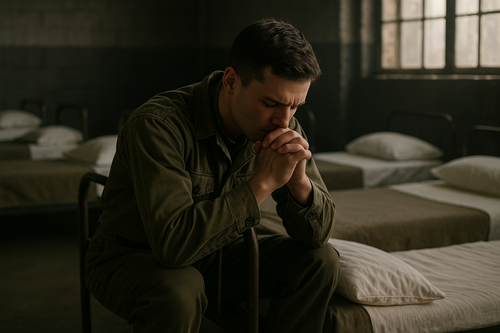
After only two months in my first pastoral assignment, I received notice to report for mandatory military service. To an Adventist living in 1959 Communist Yugoslavia, such a notice often equaled a prison sentence.
Since I was Serbian, the army sent me to Slovenia for six months of training in the medical corps. In addition to classes, daily work duties included cleaning an administrative office. Saturday was a cleaning day, so on Friday I cleaned thoroughly, hoping to rest on Sabbath. The next day as I sat in the office reading, a burly-looking sergeant unexpectedly burst in. “Pavle, why aren’t you working?” he asked. “Comrade Sergeant,” I explained, “I’m a Seventh-day Adventist pastor. According to God’s commandment, I can’t work.”
He burst out laughing. “Do you think we don’t know who you are?” His voice dripped sarcasm. “Why, we’ve been waiting to see what you’d do!” I could read the handwriting on the wall.
Then one of the officers approached me, his tone polite in contrast. “I’ve noticed that you don’t eat much,” he remarked. Indeed, most of the food contained lard, so my daily diet consisted of a slice of dark bread, salad, and milk, when available.
“I restrict my diet for health reasons,” I replied. “I’m a vegetarian.”
The Line Is Drawn
Early Monday morning I was summoned to Captain Kopchar’s office. The stern-faced officer stood in front of his desk looking agitated. “Do you know Sava Tomic?” he began.
“Yes, Comrade Captain.”
“He was here, like you. Do you know Doctor Pavlovic?”
“Yes, Comrade Captain, I know him, too.” They were Seventh-day Adventist doctors from Belgrade.
Captain Kopchar’s face darkened, and his voice rose. “We treated them well, but they would not work even one Saturday!” His eyes flashed. “You we will not treat well. You will work next Saturday or spend the next seven years on Goli Otok!”
Goli Otok would be my end. The bodies of those who did not survive this penal colony ended up in the sea. Despite this grim prospect I walked out of the office feeling curiously calm.
The next day Sergeant Milanovich approached me. “I watched you helping the Albanian recruits with their studies, and I appreciate that,” he said. “Now I want to help you. What work can you do on your Sabbath?”
“Comrade Sergeant, I can help people who are sick,” I replied.
“Good. You can assist me in the division medical clinic, X-raying all the soldiers.” We began X-raying that same day. Sergeant Milanovich did the imaging while I kept the records.
Around midafternoon in walked Captain Kopchar. He looked surprised to see me, but he didn’t say a word. As Sergeant Milanovich read the lung X-ray, he grabbed his head in alarm. “Comrade Captain,” he blurted, “you have tuberculosis in its final phase!” In spite of the captain’s protests the doctor called for an ambulance that whisked him away to the hospital.
On Wednesday I received instructions to report to the highest commander of the medical corps for the Fifth Army Command. I entered the office expecting a harsh reception. Instead the Slovenian commander invited me to sit. “I understand you have a problem with the food,” he began.
“Comrade Commander, I don’t have a right to complain,” I replied. “I’m a vegetarian.”
“But we must do something for you,” he said.
He appeared sincere, so I made a suggestion: “If the cooks would separate a portion for me before adding lard, I could eat the vegetables and beans.”
“Good enough. I’ll issue the order,” the commander responded. Overwhelmed, I silently prayed, “Lord, thank You.”
The commander looked pleased. “Now that we’ve solved your food problem, what can we do about your Sabbath problem?”
I couldn’t believe my ears. At that moment God gave me the words: “Comrade Commander, before you became commander of the medical corps, surely you were a troop doctor.”
“Of course.”
“A medical doctor studies a person’s body. A minister studies a person’s soul. If a soldier has a physical ailment, you can excuse him from work. Well, just as there are physical reasons a person can’t work, there are also spiritual reasons.”
“And what might they be?”
“Habitual practice from childhood and a conviction that God requires it.”
“I understand, Pavle. But Sunday is the day off, not Saturday.”
At that moment one of the captains interrupted. “This man deserves the day off. He works twice as hard as any other soldier.”
“I’ll do that. In that case I’ll give you Saturdays free, but you must pass Monday inspection,” the commander said.
In the days that followed, the cooks did not always remember to separate my food. When they remembered, I thanked the Lord and savored my meal. When they forgot, I thanked the Lord and went without.
My last Sabbath of training arrived, an unusually warm January day. I sauntered into the courtyard filled with soldiers. For some reason I turned toward the main gate just in time to see Captain Kopchar enter the camp. Almost six months had elapsed since an ambulance had hauled him to the hospital, preventing him from sending me to Goli Otok. How he noticed me amid the crowd I don’t know, but he walked straight toward me. I stood and saluted.
“Pope [priest],” he addressed me with a caustic smile, “they found no trace of tuberculosis on my lungs. It was a mistake on the X-ray.” Then he turned abruptly and walked away. All this time the sanitarium had detained the man because of an error on his X-ray and then released him on my last Sabbath. But Captain Kopchar was still a threat.
A New Base, Same Problems
On Sunday I departed for another Slovenian town. There I was assigned to work on the annual medical reports, cataloging the year's incidents by illness and military rank. That first night at quitting time, when the others left, I stayed and worked. Around 9:00 p.m. two doctors, Captain Kolarich and Major Gluconich, came to me. "Pavle, you need to go to bed."
"Comrades, are you quitting?" I asked.
"Oh, no. We'll be up until 1 :00 am
"If you're staying, allow me to stay too," I said. From that time on we became fast friends.
Upon completing the project, I was assigned to the division's clinic to work with Corporal Cestarich. Soon Friday rolled around. Midafternoon Captain Kolarich told me to take the rest of the afternoon and the next day off.
Early Sabbath morning, as I did each day when no one else was around, I sat on my cot and read my Bible before leaving the barracks. That afternoon Corporal Cestarich said; "Unlucky Pavle, what did you do?" I thought he was teasing. "A Captain Kopchar wrote a letter to the general about you. He said you're religiously incorrigible and urged the general to use every means to break you. After reading the letter, the general called the on-duty sergeant and asked for you. When he heard that Captain Kolarich had given you the day off, he flew into a rage. Captain Kolarich and Major Gluconich are on report right now."
On Monday I reported to work as usual. When Captain Kolarich arrived, I anticipated his anger at being called to report because of me. Instead, he smiled and said he needed me upstairs.
Upstairs Major Petrich waited, looking angry. No sooner had I entered than Major Petrich started shouting, "So you're the one who's disrupting the army. You've had your last free Saturday! I'll make you vanish from this earth!"
After he left, Captain Kolarich told me, "Pavle, I paid dearly for giving you last Saturday off."
"I understand," I replied. "I can't thank you enough for what you've already done. After all, my Sabbath is my problem."
"Be sensible, Pavle. Work while this major is here; later we'll give you your Sabbath off," he urged. "The general is behind him. He'll send you to Gali Otok."
"Would you violate your convictions if someone tried to force you?"
"I would give my life before doing that."
"Then you can understand that I will give my life for my beliefs."
The next several days I reported for work. Each day Major Petrich came into the office, shouted, cursed, then left.
Friday arrived too soon. At 4:00 I withdrew to an abandoned bath facility, my special Sabbath hiding place when experiencing Sabbath difficulties. There, in a small shower compartment, I spent precious hours on my knees praising God. Not until I looked at my watch and saw that it was past 9:00 p.m. did I realize how quickly time had flown. Tomorrow I'd probably be court-martialed. At least tonight I could get a good night's rest. So, stealing into the darkened room humming with sleeping soldiers, I crawled into my cot.
Sometime around midnight Corporal Cestarich, the doctor on duty, woke me. "Something terrible happened tonight," he said. I had worked with him in the emergency clinic, and he needed the key to the office.
When I arose at 6:00, an exhausted Corporal Cestarich came by to return the keys. He'd been up all night. "I've never had such a perplexing case," he said. "The patient suffered knifelike pains in his stomach, but he had no ulcer history."
"Did you send him to the hospital?" "The ambulance wouldn't start.
The driver didn't find the problem until dawn. I thought the patient would die. And he's no ordinary soldier, but an officer." "Which one?" "The one who swore he'd send you to Goli Otok, Major Petrich."
For several minutes I sat immobile, and a wonderful calm swept over me. I would not rot in prison. God had a work for me to do. "Lord," I said, "I will never again fear anyone on this earth. If it's Your will that I live, no one can touch me. If not, no one can save me. From now on I will witness and save souls."
The next Sabbath nobody asked for me. Four more Sabbaths passed, each spent on medical duty with Corporal Cestarich. I no longer hid. I stayed there a year, observing every Sabbath faithfully. Nobody bothered me. Soon the end of my 18-month term approached.
The Light at the End of the Tunnel
One day Captain Kolarich asked me to assist him in the mobile clinic that would accompany the First Proletarian Division's maneuvers into the snowy Slovenian mountains. One night during a pause in the action the doctor felt like talking.
"I believe in God, as you do," he said.
"How is that possible, Comrade Captain? Aren't you a party member?" "I serve time in the army to compensate the government for my education, that's all. Did you know Major Gluconich and I were called to report because of you?"
"Yes, Comrade Captain; forgive me." "Oh, no, I'm proud of that. I bet you didn't know he was once a Catholic priest. He left to become a doctor and now a major in the army. He believes in God also. Have you noticed, Pavle, that for almost a year now nobody has bothered you? They see you are protected."
During my last week a new lieutenant replaced Major Gluconich. I recognized him from the hospital in Ljubljana where I had taken soldiers for treatment. There we had become good friends. He said, "Pavle, you're leaving on Monday. But it's time again to compile our annual medical report. Please help me while you're still here."
By Friday I completed my assignment. But the new lieutenant insisted on reviewing my work with me the next day. The others told him I didn't work on Sabbath, but he had been sent by the same general who had sent Major Petrich. Early Sabbath morning he called me to an upstairs office and told me to sit down and work. I looked out the window, playing dumb and not moving. This angered him, and he stormed out of the room, slamming the door behind him.
After 18 months of giving the army my best, there was no way I'd work my last Sabbath. So I went to the clinic to visit patients. A hour later I heard voices calling my name, "Borovich! Borovich!" Evidently the major had dispatched the military police to find me.
"Borovich! Borovich!" an MP called out just behind me. He walked in, looked me in the face, and winked, then proceeded on, still calling my name. I withdrew to the unused shower stall. That evening, I returned to the barracks and went to bed.
Monday morning, my last day, I awoke early and changed into civilian clothes. As I prepared to leave, the same lieutenant called me to his office. "Where were you on Saturday?" he asked. "We looked for you all over town until curfew." "I've been here the whole time, Comrade Lieutenant," I replied.
Returning to the barracks, I gathered my belongings and left. The army had given me my documents, one day's food in a sack, and a free rail pass. I took the first train to Ljubljana. Sitting in the terminal waiting for a connection home, I leafed through my discharge papers.
"Religiously incorrigible," the character evaluation stated. To a Communist this was a terrible indictment. To me it was a noble calling.
By Pavle Borovich as told to Ann Vitorovich, Adventist Review, January 8, 2004